
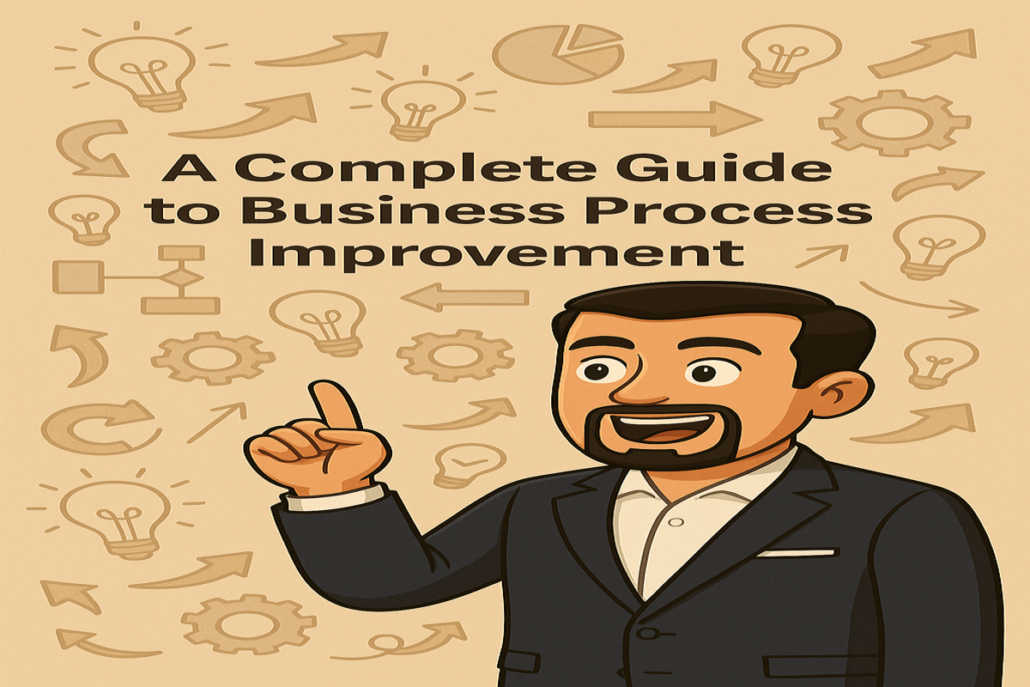
A Complete Guide to Business Process Improvement (BPI)
In today’s competitive business environment, organizations must continuously optimize their operations to stay ahead. This is where Business Process Improvement (BPI) comes in—a structured methodology that enhances efficiency, effectiveness, and adaptability of business processes.
Why is BPI important?
✅ Reduces costs by eliminating inefficiencies
✅ Improves customer satisfaction with streamlined processes
✅ Enhances agility to adapt to market changes
✅ Boosts productivity and team collaboration
In this article, we’ll explore:
🔹 The 18 stages of the BPI methodology
🔹 The step-by-step roadmap for process transformation
🔹 Best practices for analyzing, redesigning, and implementing process improvements
🔹 The role of change management in ensuring lasting results
🎥 Watch the full session here:
🔗 Business Process Improvement – Full Guide
The 18 Stages of the Business Process Improvement Methodology
The BPI Methodology consists of six key phases, each containing specific steps that guide organizations toward achieving operational excellence.
| Phase | Key Steps | Purpose |
| 1. Preparation & Planning | Process Selection, Objective Setting, Team Formation, Stakeholder Identification, AS-IS Modeling | Define scope, goals, and participants |
| 2. Troubleshooting & Problem Identification | Identifying Issues, Symptoms, and Gaps, Collecting Process Data | Pinpoint inefficiencies and data-driven insights |
| 3. Analysis & Solution Proposal | Quantitative & Qualitative Analysis, Identifying Improvement Options | Develop solutions aligned with business objectives |
| 4. Solution Control & TO-BE Design | Stakeholder Validation, Process Capability Assessment, Identifying Causes of Lack of Process Capability, TO-BE Modeling | Ensure feasibility and sustainability of new processes |
| 5. Change Management | Change Planning, Identifying Implementation Challenges, Change Testing, Stability Testing | Ensure smooth transition and adoption |
| 6. Institutionalization | Assessing Process Improvement, Standardization for Long-Term Sustainability | Embed improvements into daily operations |
Phase 1: Preparation & Planning
Before diving into process improvement, careful planning is essential. This phase ensures that teams focus on the right processes and set clear objectives.
📌 Key Activities:
✅ Process Selection: Identify processes with the highest impact on performance.
✅ Objective Setting: Define measurable goals (e.g., reduce processing time by 20%).
✅ Team Formation: Assign process owners, analysts, and stakeholders.
✅ Stakeholder Identification: Engage key participants to ensure alignment.
✅ AS-IS Modeling: Document the current process (using BPMN or flowcharts) to establish a baseline.
📌 Why this phase matters:
✔️ Sets a clear direction for improvement
✔️ Ensures alignment with business strategy
✔️ Builds a strong foundation for analysis
Phase 2: Troubleshooting & Problem Identification
Once the process is documented, the next step is to identify pain points and gather data for analysis.
📌 Key Activities:
✅ Identifying Issues, Symptoms, and Gaps: Locate inefficiencies, delays, or quality concerns.
✅ Collecting Process Data: Use historical data, process metrics, and employee feedback.
📌 Common Process Issues:
❌ Bottlenecks and delays
❌ High error rates
❌ Unnecessary manual steps
❌ Poor resource utilization
📌 Tools for Problem Identification:
📊 Process Mining – Uses system logs to uncover inefficiencies.
📊 Root Cause Analysis (5 Whys, Fishbone Diagram) – Identifies underlying causes of issues.
Phase 3: Analysis & Solution Proposal
📌 Goal: Use data-driven and qualitative insights to propose improvements.
📌 Key Activities:
✅ Quantitative Analysis: Time studies, performance metrics, and cost-benefit analysis.
✅ Qualitative Analysis: Interviews, workshops, and employee feedback.
✅ Identifying Improvement Options: Automation, restructuring, outsourcing, simplification.
📌 Example:
🔹 A company finds that 80% of invoice processing time is spent on manual approvals.
🔹 Solution: Implementing an automated approval system reduces time by 60%.
📌 Best Practices for Solution Proposal:
✔️ Focus on quick wins (high impact, low effort solutions).
✔️ Ensure proposed changes align with business goals.
✔️ Involve stakeholders in solution design to gain buy-in.
Phase 4: Solution Control & TO-BE Design
Once solutions are identified, the next step is to validate and design the future state process (TO-BE Model).
📌 Key Activities:
✅ Stakeholder Validation: Get approval from key decision-makers.
✅ Process Capability Assessment: Ensure the new process can meet performance expectations.
✅ Identifying Causes of Lack of Process Capability: Address limitations (e.g., skills, technology).
✅ TO-BE Modeling: Design the optimized process and define performance benchmarks.
📌 Why TO-BE Modeling is Crucial:
✔️ Provides a visual representation of the improved process.
✔️ Ensures alignment with business goals and constraints.
Phase 5: Change Management
Even the best process improvements can fail without proper change management.
📌 Key Activities:
✅ Change Planning: Define implementation steps and communication strategy.
✅ Identifying Implementation Challenges: Address employee resistance, system limitations.
✅ Change Testing: Pilot test the new process in a controlled environment.
✅ Stability Testing: Ensure the process remains consistent over time.
📌 How to Ensure Successful Adoption:
✔️ Training & Education: Equip employees with necessary skills.
✔️ Clear Communication: Explain the “why” behind the change.
✔️ Monitor & Adjust: Continuously track performance and make refinements.
Phase 6: Institutionalization
📌 Goal: Ensure process improvements become standard practice in the organization.
📌 Key Activities:
✅ Assessing Process Improvement: Measure results against initial objectives.
✅ Standardization for Long-Term Sustainability: Update SOPs, automate reporting.
📌 How to Ensure Sustainability:
✔️ Regular Performance Reviews – Monthly or quarterly process audits.
✔️ KPI Monitoring – Track efficiency, accuracy, and customer satisfaction.
✔️ Continuous Improvement Culture – Encourage employees to suggest further refinements.
Final Thoughts: Why BPI is a Game-Changer
Implementing Business Process Improvement (BPI) can lead to massive efficiency gains, cost savings, and better business outcomes.
📌 Key Takeaways:
✔️ Structured approach ensures systematic improvements.
✔️ Data-driven decisions lead to higher efficiency and quality.
✔️ Stakeholder engagement ensures smoother implementation.
✔️ Change management is critical for long-term success.
🎥 Watch our full session on BPI here:
🔗 Business Process Improvement – Full Guide
🚀 Start your journey toward business excellence today! 🚀


 freepick.com


Fancy a spin? I dropped into pg888pg88 and it had a good vibe. Easy to navigate and some fun options. See what you think: pg888pg88
Yo, ar777! Been spinning reels here and there. Gotta say, the adrenaline rush is real. Could use a bit more variety in the slots, though. Check it out yourself: ar777
22atmgame here! This is where a great selection of online games and money making meet! Good for a quick buck with great payouts. Try it yourself: 22atmgame
https://shorturl.fm/5ddcr
https://shorturl.fm/dzaZP
The VIP perks on this site are actually legit. I feel like a valued player here and the customer support is super helpful. You should give 96xbajeevip a shot!